BOOK PURCHASE: Discount (above) or PayPal (below)
Click "Buy Now" to continue to PayPal
Click to order eBook - Kindle

Click to order eBook - Nook

Oct
12
Dang – These Stats Are Amazing
Filed Under Black Lions, Combat PTSD, Life, PTSD, TBI & PTSD, Tears of a Warrior, War | Comments Off on Dang – These Stats Are Amazing
by Janet J. Seahorn, Ph.D.
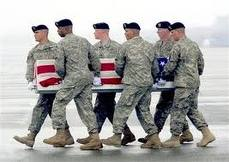
As you might imagine, we have been doing research and accumulating multiple types of data for well over ten years. Much has been on PTSD along with statistics on various numbers of vets who served in different wars, as well as their injury and death counts.
Over the last two weeks we have had numerous individuals send us a variety of articles and information on the Vietnam War. Perhaps the most startling was a number that I checked out through several sites; it was a number that claimed only 1/3 of veterans who served in Vietnam are still alive. This number was part of a 2000 census count, so I can only assume the number is far lower ten years later. The actually statement was “Of the 2,709,918 Americans who served in Vietnam, less than 850,000 are estimated to be alive today”.
Yikes. This is a number neither Tony nor I ever expected. Perhaps we don’t want to admit that we are growing that much older. Or perhaps the numbers may show an underlying concern with the health of Vietnam vets who endured massive amounts of toxic chemicals while serving in the war zone. At any rate, the small number of Vietnam vets still living is a real worry.
Another statistic that we have seen is that of the 9,087,000 military personnel who served from August 5, 1964 – May 7, 1975, only 2,709,918 actually served in Vietnam. Of those who were in Vietnam, only around “40-50% either fought in combat, provided close support or were at least fairly regularly exposed to enemy attack” (Bob Beavis, 2010).
And most alarming in a 1995 census around 9.5 million individuals falsely claimed that they had served in Vietnam when they had not; in the 2000 census almost 14 million individuals falsely made such a claim. Yikes, no wonder the Veteran’s Administration is having a harder time trying to identify who did and did not serve when there are so many “false” claimants in America. As my grandmother would say, “Shame, shame, on all of them”.
Last, and this I find very interesting given the amount of press that has been given to the number of Vietnam vets who were supposedly alcoholics, drug users, and homeless, according to various vet sources (VFW Magazine, the Public Information Office…) there was/is no difference between those populations who served in Vietnam and those who did not.
Also, we often hear about how many Vietnam vets ended up in prison… simply not true. Vietnam vets were less likely to be in or served time in prison – only ½ of one percent (Bob Beavis). Over 82% of Vietnam veterans seemed to have made a pretty successful transition to civilian life in spite of dealing with severe injuries and PTSD.
So congratulations all you Vietnam vets; you have lived a truly exceptional life, served your country with honor, and had the incredible strength and internal courage to continue to live life with high principles and personal pride.
Jan
28
Tears of the Children
Filed Under Trauma | Comments Off on Tears of the Children
by Janet J. Seahorn
Normally our blog focuses on the effects of combat trauma to military personnel, their families, friends, and communities. Today is moving to the broader devastation of trauma. Trauma not caused by war and hate, but by nature. Trauma, that even with the greatest technological advances of man, cannot be halted or many times even predicted beforehand. Such is the current state of Haiti.
For me the effects of war trauma on children may be even worse, because it is not due to outside forces of nature, but hate, greed, or lack of compassion for others. Hate which is colored by the darkness of men’s hearts and even nation’s souls. Unlike nature, the torture and killings go on for years, with little hope of relief.
In Haiti, however, what we continue to see are a people doing what they can to help their neighbors and communities. Yes, there is looting and even violence. Desperate people act in desperate ways when one’s life, and the lives of one’s families are at stake. Fighting for the every day things most of us take for granted: water, food, a safe place to sleep, medical care… and the list grows.
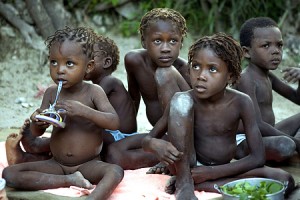
When looking at the photos of children, I can’t help but wonder what are they able to understand about this terrible event? How can they make sense of horror? In a country where hundreds of thousands of children were abandoned before the earthquake, who will take care of these babies and children now? Who will hold and comfort them? Who will help to explain the experience and give them the physical and emotional support to heal?
What we currently know about childhood trauma is that it can be more difficult to heal. The brain has not connected the higher order neural networks that help adults sort out the facts of any event. Adults have far more coping skills. Children, have far fewer in their young minds. They have not lived long enough or had enough experiences to compare or sort out the hues of trauma. Their world is very concrete – what one sees is what one understands at a very concrete level.
We used to believe if a terrible act happened early in life, the person could more easily mend. Current neuroscience has proven this belief is a highly inaccurate myth. The earlier the trauma on a young brain, the worse the effects can be if the child is not given the physical and emotionally support needed for healing. Healing that will allowed the child to grow in a world where he/she can still feel safe. Healing that offers hope and resilience from future traumas because they were loved, comforted, and supported when they so desperately need these acts of security.
Therefore, keep all of our children in your hearts and prayers, whether they are in Haiti, Afghanistan, or your own neighborhood. Pray for the mending of our children’s bodies, minds, and hearts. They are the world’s future. We must do all that is necessary to try to ensure that their future is built on a foundation of compassion, kindness, and humanity.
Oct
20
PTSD Suffering & Control
Filed Under PTSD, Trauma, Treating PTSD | 1 Comment
By Janet J. Seahorn
This may be one of the most important blogs that I have written. Important because we are quickly becoming a people who, due to the recent attention on Post Traumatic Stress, are beginning to lump into the same basket all vets who return from conflict challenged by PTSD.
This is a major dilemma. It is vital that we as a nation, as communities, and as families start to have a more accurate description of the effects of combat trauma. Important because without correct information, we cannot help to mend the minds, hearts, and souls of those who suffer.
For that reason, solid facts through research on PTSD lead to better care. The problem, however, occurs when the media focuses only on those individuals who behave in extreme ways. Ways that make news casts, papers, and internet reading more exciting.
For the vast majority of veterans who return from combat tormented by the memories of war, the battle is within and remains there, silently distressing the individual.
But here is what is key to remember; the majority of vets are not personally or professional “out of control”. In fact, they spend a tremendous amount of time and energy trying to remain in control. For many, the periods of distress are when the person is alone, safe within the confines of house and home, or experiencing a severe physical or family crisis.
For most, the only people who see the anxiety and panic are not the outside world, but rather those within the vet’s inner-most circles: spouses, children, siblings, parents, and very close friends.
There are already many young (and some older vets) who are refusing to acknowledge they have a problem, or seek medical interventions even when they realize they need it. And why would they? Fearing they will be labeled and thrown into that “media basket” of dysfunction, they prefer to maintain a mask of silence. This isn’t acceptable, nor is it effective in mending the situation.
Yes, PTSD is a reality for many in our world, not just combat vets. For sure, it is a challenge like any “reordering” of the mind and body. Yet, most individuals move forward to live productive, successful lives. And if the individual gets appropriate medical and professional attention, that life and those who are closest to him/her, the living becomes immensely easier.
So let’s begin to write and tell stories of these quiet, courageous men and women. Stories of heroes and heroines who survive and manage to prosper in many areas of their lives; appreciating the fact that to be a hero requires an extraordinary act of bravery within an ordinary human spirit.
May
8
 A few weeks ago, during a book publication meeting, I met a lovely lady, Lois Hjelmstad, who had written a book, Fine Black Lines, of reflections of how she survived cancer told in journal entries, reflections, poetry, and photographs. One of her poems reflected what many veterans and their families have experienced when living with PTSD. Since many of life’s challenges have “emotional” similarities, I thought our blog readers might find this particular selection meaningful.
It’s best to act normal…
To say, “I’m just fine.”
What everyone wants is
A positive sign.
Just smile and say thank you
When people will ask.
One mustn’t let on that
Each day is a task.
Friends keep on calling…
You know they mean well.
But really they’d rather
For you not to tell
Each symptom, each detail,
Each wearisome day.
Or mention that small fear
You can’t drive away.
An illness gets tiring…
For them and for you.
The difference is simple…
They get to quit.
( © 2003 Lois Hjelmstad)
303.781.8974
Wouldn’t it be great if, when the demons appear, one could simply say, “I Quit”, and everything would be normal? The reality of the situation is that warriors Never Quit, they keep on going no matter what battles they are waging. For that, my friends, is the very essence of a true warrior.