BOOK PURCHASE: Discount (above) or PayPal (below)
Click "Buy Now" to continue to PayPal
Click to order eBook - Kindle

Click to order eBook - Nook

Feb
18
AGAINST ALL ODDS
Filed Under Combat PTSD, Healing, Hope, Life, PTSD treatment, Tears of a Warrior, Treating PTSD | Comments Off on AGAINST ALL ODDS
by Janet J. Seahorn, Ph.D

PREFACE
For too many individuals, there may often be days when one feels he/she cannot continue to withstand the struggle and obstacles of the many agonies of the past. The feelings can be overwhelming and consume our minds and bodies with darkness. It is at this time when a favorite, inspirational quote or a poem of encouragement may help us get through a really bad day. It is for this reason, I wrote the poem, Against All Odds. If we believe we can, hopefully, we can. And surely as there is day and night, sunshine and rain, joy and sadness, if we believe we can’t, then we won’t.
AGAINST ALL ODDS
Janet J. Seahorn
Against All Odds I will survive.
Courage and grit will be my guides.
Against All Odds the demons within
May sometimes grow but never win.
Against All Odds I will find joy
Hate and chaos I will avoid.
Against All Odds I’ll fight my fears
And not be afraid of cleansing tears.
Against All Odds I’ll endure my pain
Knowing that rainbows come after a rain.
Against All Odds I shall be kind
Even if anger sways my mind.
Against All Odds I’ll choose to believe
That peace and happiness I can receive.
For this I know without a doubt
Against All Odds I will win out.
You not only can, but will do what needs to be done to be healed, to be whole, to be healthy in mind, body, and spirit…Against All Odds.

Oct
7
WARRIOR DEDICATION
Filed Under Brain Injury, Combat PTSD, PTSD treatment, TBI & PTSD, Tears of a Warrior | Comments Off on WARRIOR DEDICATION
by Janet J. Seahorn, Ph.D

Here is a question to think about…how many of you would take your entire retirement in one lump sum and then put it into a facility that would serve as a place of support, safety, and relaxation for our country’s vets?
This special place would require quite a bit of work. You would need to paint the walls, put in new furniture that would be comfortable and calming, and develop programs that would facilitate a wounded warrior’s emotional and physical well-being.
Such a facility would need quiet places where an individual could find the best environment to heal. For instance, one room would serve as a large conference room for presentations and discussions. Another would be a smaller area with a number of large reclining couches as well as chair recliners. My favorite happens to be a room with three oversized, state of the art massage recliners.

Each of the two “relaxation” rooms is equipped with head phones to listen to select music of choice under dim lighting. Small water fountains provide a sense of a quiet, flowing river. A large screen TV scrolls messages of hope and inspiration. Every detail was thoughtfully conceived to provide a special place of peace.
And here is the amazing thing, the person who has formed this sanctuary does not charge one cent for a veteran or family member. The Warrior Relaxation Response Center is located on the south side of Colorado Springs, CO, close to Fort Carson military base. It has been open barely a year. To continue to provide these services, the owner, Antoine Johnson, is desperately trying to obtain grants from various organizations as well as the army’s military base.
With a challenging economy, this will be no easy task. As Antoine tells it, “It is a true leap of faith”. He explains that he simply loves the military men and women who served our country. He and his wife spent many years in the army, fought in Desert Storm, and then became teachers. Working with traumatized children became his specialty. Many of the children came from military families torn apart by combat deployments, with parents returning with TBI and PTSD. Antoine saw a calling to help those returning from war to achieve a more stable and balanced life.

Last Thursday we were invited to visit the center and speak to some of the veterans and their families. Young and old were present, each with a story of trauma The flashbacks, the lack of understanding from family and friends who have not had to endure war, the numbing of the senses just to get through the day, and the sometimes overwhelming anxiety of not knowing when the next emotional attack will occur.
Throughout our country there will be an even greater need for more centers like the Warrior Relaxation Response Center A place where an individual can visit to simply be alone and find some solace. A place where he/she will not be judged, asked questions, or encouraged to just get on with living. Sometimes, as Antoine understands, a warrior simply needs a quiet space. Healing takes time, often a lifetime.
For those who want to contribute to support this mission or learn more about the facility please contact Antoine Johnson: http://www.warriorrrc.com
Feb
15
WICKED PROBLEMS
Filed Under Combat PTSD, PTSD, PTSD treatment, Tears of a Warrior, Trauma, Treating PTSD, War | Comments Off on WICKED PROBLEMS
by Janet J. Seahorn, Ph.D
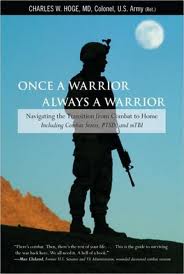
No doubt about it, PTSD is a very Wicked Problem. Wicked Problems, by definition, are those dilemmas that cannot be solved easily by using a typical approach. Anyone living with traumatic stress, especially those pressures caused by combat, will attest to the challenges of trying to solve the predicament of moving through his/her life carrying the memories and phantoms of war. If the solution was easy, it would have been found centuries ago. Yet, here we are today, in 2011, and the Wicked Problem still exists.
One of the Wicked Problems of trauma is surviving the depression that can be a part of the conflict. How does a person live with long-term depression that often becomes the new normal after battle? Constance Gibbons, one of our readers, wrote last week and shared how depression has been the new normal for many vets including her husband. After years of having it a part of their daily being, it becomes their after war identity. She stated: Another interesting aspect from those of us observers – spouses, et al – was that universally we noted the levels of sort of a baseline enthusiasm, whereas, the vet thought they were quite fine.
She explained further: As you continue to think of ‘depression’ as it may be portrayed by the vet, maybe think of a sense of resolution, unknowing acceptance, somewhere in a lower zonal level (between overconfidence and fear) from the years of living on the cusp of life and death, at a level of continuing risk so great that without the impact of the continuing penetration, after, into youthful vulnerability, it appears to those of us in observation to be baseline depression…where it is not to the vet; just an absence of heightened stimulation. Wow, now how would anyone solve such a Problem?
Veterans carry many Wicked Problems – ghosts of death and shocks of battle, memories that make if difficult to stay grounded in every day activities, and struggles to avoid the sleepless nights where staying awake is one way to keep the dreams of foreign battles from returning. New therapies and medications have helped lower the impact of PTSD but it has not solved the Problem. I read many blogs and articles relating combat PTSD to the trauma that the average person might experience. Things such as car accidents, rape, assault… all which are terrible and difficult to cope. Yet, these are hard to compare to combat where trauma occurs every day, often numerous times in a day. One of the biggest differences is besides being the prey, in combat you must also become the predator. Instead of being involved in one brutal injury or death, you may experience many.
Fighting the Wicked Problems of war takes work. It requires listening to your gut feelings as well as how others around you perceive your behaviors. The good fight involves muffling the loud voices in the head long enough to examine realistic solutions. Perhaps there will be no absolute solution to PTSD, but every day there are warriors who conquer their demons and live full and meaningful lives. Wicked Problem you may remain, but you will not take more of a warrior’s life than you already stole. You will not win this internal war, even if you succeed in taking an emotional battle now and then. You see, Wicked PTSD Problem, in spite of your persistent, you are no match for the courage and willpower of a WARRIOR.
Nov
23
Humility & Bravery Visible
Filed Under Combat PTSD, Life, PTSD, PTSD treatment, Tears of a Warrior, Treating PTSD, War | 2 Comments
by Janet J. Seahorn, Ph.D
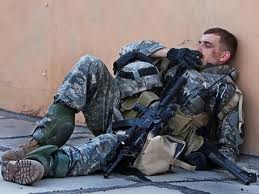
The day was wet and overcast.
Upon arriving at the VA Hospital in Denver, we noticed how many patients seemed to be waiting for a bus or a taxi. Tony didn’t appear overly eager to walk into the building. Just looking at the entrance from the outside made him nervous. Walking inside was even worse. Almost forty years ago, this was the place he went to get help for the nightmares and panic attacks he was experiencing after returning from Vietnam. A young therapist at the time, untrained and unskilled in working with military personnel thoughtlessly told him to be grateful he made it home, and get on with his life. For thirty years, Tony never went back there… or anywhere else for assistance.
Thank goodness we now have a verifiable diagnosis of these frightening memories; it is PTSD, and veteran centers across America are far more proficient in caring and supporting our wounded troops. Nevertheless, Tony had not been back to the Denver VA Hospital until Monday. We were going to talk with troops in the PTSD Unit of the hospital. This is a seven week program where vets get intensive counseling and treatment for their combat traumas. Today there are nineteen men attending the afternoon discussion. Humility can’t quite describe what we feel when we do such meetings.
The majority of the vets were from the Vietnam era with the remaining members from Iraq and Afghanistan. I am pretty sure most people have little understanding of how much suffering each patient has survived; years of torment and silent screams. Each face revealed a unique map of torment. It appeared that every wrinkle held its own story, its own remembrance. Yet, it was the younger warriors who made the most emotional impact. Perhaps this was because they reminded us of our sons. Or perhaps, we were too familiar with the pain they were experiencing and the long journey still ahead. Youthful faces were not yet lined with creases, though their eyes held an even deeper look of anguish. Yesterday’s combat field was not that far from today’s reality. Time had not yet put any distance from the rawness of war. Where several Vietnam vets were willing to talk, the young fighters stayed silent.
At the end of the afternoon, one young marine told me how difficult it was for his mother to understand what was happening to him. He talked about how she just kept saying, “Why don’t you just get better? Why aren’t you back to your old self? You weren’t wounded, what is the matter with you?” and then he said sadly, “she told me, why can’t you just take a pill and be OK?” Then he quietly stated, “I’m trying’ I’m really trying, but I just can’t seem to forget, no matter how hard I try.”
It was heartbreaking to watch him describe his situation. First he endured the many horrors of combat. When he came home, he had to endure the unawareness of the “ordinary” people.
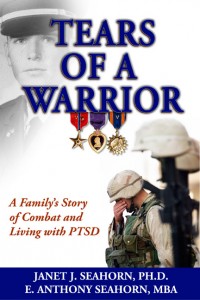
Next, there was the tall, thin youth who sat shifting in his chair seeking a more comfortable position. His back pain was obvious, especially when he cautiously walked bracing his weight with his cane. The sweetest, shyest smile spread over his face as he approached. What he requested was an extra copy of our book, Tears of a Warrior. He wanted to send it to his wife, hoping she might read it before he returned home from the hospital. Perhaps she would gain a better understanding of his condition. Perhaps, by understanding, she would be able to bear the years ahead. Perhaps together they might make it though the dark times still to be faced.
More than ever, I am touched by the courage the young and the old veterans demonstrate. A valor that leads them forwarded searching for a small bit of peace. By making that huge leap of faith to enter this seven week program, they lay bare their demons, hoping by exposure to the light these may leave, or at least become less frightening. For most, I believe this will be true.
Like in combat, sometimes to survive, one must rush towards the enemy fighting with every ounce of power he/she possesses. Healing requires that same force of power – rushing towards the demons, lets them know you no longer will run from them. When the hiding ends the healing begins.
Have a healthy and Happy Thanksgiving.
Jun
30
PTSD Series Discussion #5
Filed Under Brain Injury, Combat PTSD, PTSD, PTSD treatment, TBI & PTSD, Tears of a Warrior, Treating PTSD, War | Comments Off on PTSD Series Discussion #5
By Janet J. Seahorn
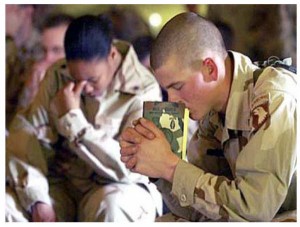
When is it time to seek outside help?
This is pretty easy to answer: You will know if it is time to seek outside help when the behavior of the serviceperson becomes abnormally un-normal. When life becomes a teeter-totter of ups and downs that can’t seem to be controlled no matter how hard you try. When your surroundings and relationships seem unstable and unsafe and you aren’t sure why, get help.
When my husband began experiencing PTSD, neither one of us had a clue what was going on at the time. There was no such thing as Post-Traumatic Stress. War was something that a person went to, came home from and tried to move on. It wasn’t discussed. It wasn’t thought about (or so we once thought and wanted to believe).
No one considered how the events of combat could impact an individual for the rest of his life. If you came home somewhat physically whole, that was a gift. You healed physically, and you lived as if all the horror from battle never happened. The past was the past and it should not impact one’s future. What an absurd assumption.
Now we understand that nothing in our past is ever fully in the past. The good and the difficult follow us wherever we go. We are part of our experiences. With understanding, courage, and information we may gain strength and wisdom to move forward. Getting outside help can guide us in forming the wisdom and understanding needed for healing.
What are some good resources for help with PTSD or TBI?
There are many resources available to our military service men and women. Check with your local Veteran’s Administration Center if you suspect you need support. You may need to be referred to a Veteran Hospital for further testing and diagnosis, especially if you suspect a traumatic brain injury. Every state has several local centers that have been established to help veterans find the appropriate placement and support needed to get the services they may require. (VA Centers are listed in our book)
Don’t stop at NO if you are convinced you have something wrong that necessitates some form of treatment. Sometimes all you need is that one special person who can take your situation seriously enough to get help. Our family personally saw this happen with my brother. He was extremely wary of anyone associated with the government. As a Vietnam vet, his mistrust of a broken, ineffective system made him reluctant to seek help from a military or veteran organization of any kind. Once he decided to seek services he ran into several brick walls. Yet, he kept trying, until he finally found a former army sergeant who took his situation seriously and made things happen.
It only took one person to make a difference. Don’t’ give up or give in to frustration. Keep going. Help is available, but sometimes you may have to fight for it just like you did in battle. If you did it then, you can do it now.
In ending, we want to thank you and your loved ones for your service and sacrifice. You have made a difference that few will understand, or perhaps fully appreciate. Nevertheless, please recognize the depth of your courage, strength and warrior spirit. These are the attributes that sustained you through combat, and now they will do so again in moving you towards healing and a better life.
May
25
PTSD Series Discussion #3
Filed Under Combat PTSD, PTSD, PTSD treatment, Tears of a Warrior, Treating PTSD, War | Comments Off on PTSD Series Discussion #3
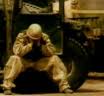 Question 4: If I, as a serviceperson, have PTSD, how can I help myself?
First, be honest with yourself. As stated in the last question, do not ignore the signs that you are suffering from serving in combat. Do not pretend that things are fine; that the problem lies with everyone around you such as your spouse, children, neighbors, family, or co-workers. Watch for signs such as increased anger, irritability, depression, and/or isolation from normal family events. Resisting the feelings associated with PTSD only exacerbates the problem. The best thing you can do if you think something is not normal is to visit your Veteran’s Center as soon as possible. These centers have become much more proficient in serving the military population’s needs than they were during past conflicts. Physicians and therapists now recognize and understand in better detail the effects of PTSD and how to treat it. Don’t wait. Help is available. The sooner you get assistance, the sooner your life will begin to move forward in a manner that allows you to live more fully. You deserve to be at peace, to be happy and so does your family. You and your loved ones have given enough in serving your country. Now it is time that your country does something for you. Help is waiting; don’t wait another minute to get it. Life is too precious to be wasted fighting demons from the past. Today is the only thing you have that will make a difference for tomorrow. So use today wisely to gain understanding, healing, and perhaps some peace of mind and spirit.
Other suggestions include spending time outdoors. Nature offers us a tremendous healing environment, especially for emotional wounds. We find hiking, fishing, skiing, and simply just being in the wilderness soothes much of our anxieties and internal tensions. Pets are also a therapeutic comfort. A great deal of research has been conducted that has shown the positive impact animals have on a person’s well being. Because our pets love us unconditionally, are non-judgmental, and provide a sense of safety and security, they are one of the very best options for keeping us sane and healthier both physically and emotionally. A few additional suggestions that we have found quite beneficial are meditation, aroma therapy (no kidding J), body massage, and heavy doses of laughter. Humor is a terrific medication since it is almost impossible to be angry and laughing at the same time. It releases endorphins that alleviate body pain, and provides a huge dose of oxygen to the brain and muscles.
Question 5: What can I, as a family member, do to help someone with PTSD or a TBI?
There can be a major difference between a person suffering from PTSD and someone who has incurred a TBI (traumatic brain injury). A TBI is a physical injury to the brain, where PTSD is more a reordering of the neuro networks in the brain. Many times a person with a TBI may also have some form of PTSD, mainly because he/she was in a situation that caused physical and emotional damage to the individual and/or others in the company. As with all illness and trauma, the more informed you become the better you are at making appropriate decisions in handling the circumstances. Illness and problems must first begin with immediate recognition that something is not quite right. The sooner you recognize the signs of PTSD, the sooner you can begin the healing process. Once again, it is dangerous to ignore the obvious and pretend things will get better with time. Too often, this does not happen by itself. Time can make behaviors and tensions more precarious, destroying personal relationships and family cohesion. No one benefits by waiting. Spouses get tired of walking through the “mindfields” of the traumatized serviceperson. Children suffer because they can’t and don’t’ understand why mommy or daddy are not always the same kind; loving parents they were before war.
When a family member returns from combat with PTSD, everyone close to him must join together to offer support, hope, and comfort. In doing so, however, you must set suitable boundaries that will keep the family safe and well-balanced. If children are involved, they must be at the forefront of your concern. Their physical and emotional well-being is of utmost important. Living with a parent who has untreated PTSD can have long-term, negative consequences on a developing child. Getting immediate treatment for your spouse and yourself will be the best line of defense in moving towards the life you want to live and the family unit you want to be.
Nov
6
When Humpty-Dumpty is Mom
Filed Under PTSD treatment, Today's War, Treating PTSD, Women in Combat | Comments Off on When Humpty-Dumpty is Mom
by Janet J. Seahorn

War is hell, and there is no polite way to put it.
But when modern war is fought by women as well as men, it can take an even more challenging toil on a family and community.
As Americans, we are quickly learning that our country and its military facilities are struggling to provide appropriate treatment for its female troops. There are many services for men; yet, we are not prepared to offer some of the same options for women.
This week I had two events occur from two different parts of the country. The first was a disturbing phone call from a friend, who has several family members serving in the military. All have fought in Iraq. Her son has been to both Iraq and Afghanistan on numerous tours of duty.
Her concern, however, was for her female family member. After serving in Iraq the military woman has been home for almost three years, taking care of two small children while working full time in a demanding job. The young mother had been exposed to a great deal while deployed, and has done her best to return to normal life stateside.
Most of the time things are fine, but a few weeks ago, the memories, anxieties, and panic attacks returned with a vengeance. As we have discussed numerous times in our blogs, the ghosts of combat often come back to take up residence in the homes of the military personnel.
Without hesitation, this bright lady and her family sought help through the VA. She has wisely enrolled in our local VA Clinic upon return from combat. This time, however, she would need more intense treatment.
Not a problem, except, that the only facility that could accommodate women only is in another state, making the decision to leave her family and work a great deal more difficult.
The second incident came via an article in the New York Times which was sent to me exactly two days after the first event. Reading over the article’s information was all too familiar. I had heard it just two days before. The article by Damien Cave stated, “Never before has this country seen so many women paralyzed by the psychological scars of combat.
As of June 2008, 19,084 female veterans of Iraq or Afghanistan had received diagnoses of mental disorders from the Department of Veteran Affairs, including 8,454 women with a diagnosis of post-traumatic stress — and this number does not include troops still active, or those who have never used the V.A. system” (Internet, Nov. 1, 2009).
The article continued to comment on what we have heard from many female vets, that because they are women, “people underestimate what these women have been through” (Resick, Internet, Nov. 1, 2009).
Since war has been traditionally fought by men, we have seen the Humpty-Dumpty effect. But what happens when Humpty is Mom? What happens when Mom is the wounded warrior? What happens to the children? What happens to the organizational system of the home: the washing, cooking, cleaning, and daily tasks?
Who steps up to help nurture the nurturer when she needs comfort, care, and support? These are vital questions that need to be explored and addressed.
When Humpty-Dumpty is Mom, she can be put back together; however, the tools and glue may be pink instead of blue.
Sep
16
The Strength of One
Filed Under Civilian life, PTSD treatment | 6 Comments
-by Janet Seahorn
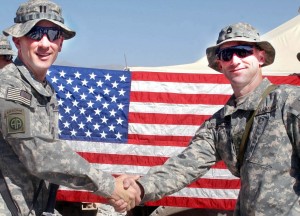
It had been several months since I last saw him. The end of last semester during finals to be exact. He had been a student in one of my university classes. He was a big, strapping, young man who almost always had a smile on his face and some funny comments to amuse his table mates.
Before that semester began, I knew that several of my new students were National Guard or had served in the military; he was among them. On one occasion, he told me that he had been on active duty and had just returned from a tour in a war zone. Iraq one day, and the next day he was signed up and attending classes at the university. No transition time whatsoever. Yet, he seemed to take it all in stride. He even joined a fraternity.
A few times I had spoken with him about some of his experiences and asked if he knew anything about Post Traumatic Stress. Without much dialogue he nodded and mentioned that he had some symptoms but he was coping quite well. And by all outward appearance and on most days he was fine. Only a few times did I recognize the demons had visited him, but thankfully, they didn’t seem to stay very long.
The semester wore on without much concern until the last month when he was absent a few times – until then he attended every class and only missed on rare occasions. One absence occurred the first day of class. He had e-mailed me ahead of time to let me know he would be missing that session because he was attending the funeral of one of his best friends. Only later did I learn the funeral was a young marine who had been in our local papers and had recently died in Iraq.
The marine had been a close high school friend. They had been star players on their football team, shared Saturday night outings built on a foundation of boyhood friendship.
After our “catch-up” talk, he mentioned that the summer had been tough. He had an accident which broke some bones in his ankle. He could not participate in all of the fun activities that had anticipated during the school year. Given the pain and the down time of recuperation, the memories resurfaced; the trauma of his tour of duty in Iraq, what he saw and had to cope with, the decisions he had to make on a daily basis – returned to haunt him.
Typical of his strong personality, he downplayed most of the symptoms. Yet, this is an intelligent young man. He did not dismiss the symptoms and stated that he was getting help for his PTSD. Just knowing this put my mind at ease. I could only imagine what courage it took to take this step. Hopefully, other vets who know him will follow his example. He will get better – faster, in a healthier manner.
Just a side note: I no longer choose to call this a “disorder”. It seems to me the more I learn and understand this phenomenon, the more I believe that PTS(D) is the minds/body’s incredibly creative way to deal with an unusually horrendous life event.
Had the mind not employed the immediate reaction of numbing and stuffing the event, the person may have died. To avoid the ultimate death sentence, the mind/brain made a split second decision to unconsciously remove itself from the trauma until a later time; a time when the body was safe to explore the event without being in the line of fire.
Pretty amazing and effective when you think about it. If the brain wasn’t such a protective, innovative problem solver many of us would not be around today. Yea, for our amazing brain. Maybe it is not “disordered” at all, just creatively restructured for a bit.
In a few weeks I will attend a conference on Traumatic Brain Injury (TBIs). Of course I will be writing about this experience and sharing some of the information with our blog readers. Stay tuned.
Sep
1
Never Apart
Filed Under Dogs, Pets, PTSD treatment, Purple Heart | 1 Comment
by Janet & Tony Seahorn
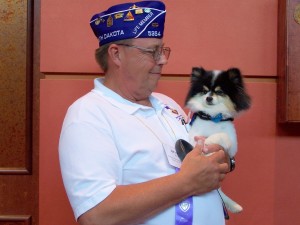 It was a small, black & white, furry 5-pound bundle of emotional and physical relief. His name was Petie, the keeper of an adult warrior, Purple Heart, Vietnam Veteran.
The vet trained him as his first alert. An important task. Petie knew when his master needed to take his medications. He would wakeup Dennis at various times in the middle of the night so that specific pills were administered at the most critical time in order to keep the Post Traumatic Stress under control.
Dennis trained Petie especially for this purpose. They are best friends and constant companions, never apart. This small, furry medic is essential, not just for the vet’s physical well-being, but even more important, his emotional/mental stability.
Petie alerts Dennis when there is danger in the surroundings. He watches intently everything that goes on with his owner and around his owner. If Petie isn’t comfortable his master knows to pay closer attention to his current environment. If Petie doesn’t like you, more than likely Dennis isn’t going to become too friendly either.
They coexist, two different species, one functioning entity.
There are numerous organizations that train service dogs. Dogs that serve the deaf, blind, and epileptic individual. Dogs that act as the arms and legs of those who no longer have capacity to move on their own. Now, some of these groups are training dogs to do something even more challenging, knowing when their owner may go into a PTSD anxiety attack.
The dog must sense when such attacks may occur before they actually manifest themselves. They know even before the person that something is coming on – giving their owner an opportunity to breathe, use relaxation techniques, and take medication if necessary. They provide a sense of security and well-being in a world filled with unpredictability and potential stressors.
One such training organization is NEADS – Dogs for Deaf and Disabled Americans.
They are conducting an in-depth study of nine-ten Iraq vets who has severe PTSD. The study’s focus is to evaluate the most effective canine training methods that serve the sensitive needs of a veteran suffering from combat stress.
This is a very expensive and challenging research project because it must take into account the behaviors of two very different organisms: human and canine.
It will be a critical piece of information given the increasing number of individuals returning from the Iraq and Afghanistan theaters and those that have served in past wars such as Vietnam and the Gulf War.
Mar
10
Freedom dogs help with PTSD
Filed Under PTSD treatment | Comments Off on Freedom dogs help with PTSD
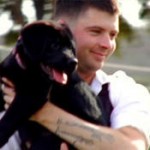
We’ve all seen how dogs and other pets can have healing powers. A pilot program in California pairs service dogs with returning veterans with brain injuries and emotional problems. Freedom Dogs is a non-profit agency in San Diego that trains service dogs to do anything from retrieving items to providing a comforting distraction from PTSD symptons. To read the full story, click here.