BOOK PURCHASE: Discount (above) or PayPal (below)
Click "Buy Now" to continue to PayPal
Click to order eBook - Kindle

Click to order eBook - Nook

Oct
10
Healing with Awe
Filed Under Combat PTSD, Faith, Healing, Journey, Nature, Peace, PTSD treatment, Tears, Tears of a Warrior, Treating PTSD, Veterans | Comments Off on Healing with Awe
by Tony Seahorn

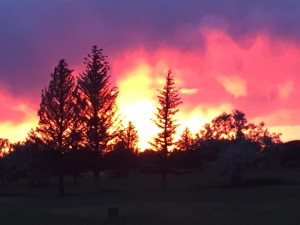
We often talk and write about spending time in nature as an important element of the healing process.
For those with Post Traumatic Stress (PTSD or more accurately PTS), finding solace in natural places helps us realize and appreciate the marvelous wonders of the world.
Following is a link to an article that appeared this weekend in Parade Magazine worth reading.
Living in awe…
http://parade.com/513786/paulaspencer/feeling-awe-may-be-the-secret-to-health-and-happiness/
Feb
18
AGAINST ALL ODDS
Filed Under Combat PTSD, Healing, Hope, Life, PTSD treatment, Tears of a Warrior, Treating PTSD | Comments Off on AGAINST ALL ODDS
by Janet J. Seahorn, Ph.D

PREFACE
For too many individuals, there may often be days when one feels he/she cannot continue to withstand the struggle and obstacles of the many agonies of the past. The feelings can be overwhelming and consume our minds and bodies with darkness. It is at this time when a favorite, inspirational quote or a poem of encouragement may help us get through a really bad day. It is for this reason, I wrote the poem, Against All Odds. If we believe we can, hopefully, we can. And surely as there is day and night, sunshine and rain, joy and sadness, if we believe we can’t, then we won’t.
AGAINST ALL ODDS
Janet J. Seahorn
Against All Odds I will survive.
Courage and grit will be my guides.
Against All Odds the demons within
May sometimes grow but never win.
Against All Odds I will find joy
Hate and chaos I will avoid.
Against All Odds I’ll fight my fears
And not be afraid of cleansing tears.
Against All Odds I’ll endure my pain
Knowing that rainbows come after a rain.
Against All Odds I shall be kind
Even if anger sways my mind.
Against All Odds I’ll choose to believe
That peace and happiness I can receive.
For this I know without a doubt
Against All Odds I will win out.
You not only can, but will do what needs to be done to be healed, to be whole, to be healthy in mind, body, and spirit…Against All Odds.

Jul
23
I SAW GOD TODAY
Filed Under American Patriotism, Giving, Healing, Healing Waters, Soldier, TBI & PTSD, Tears of a Warrior, Treating PTSD, Wounded Warriors | Comments Off on I SAW GOD TODAY
by Janet J. Seahorn, Ph.D

I saw God today. He appeared in many forms and shapes. Some were tall with crippled arms and legs. Some were young with broken hearts and tangled minds. One was weathered with a long, white-bearded, grizzly face. Amazing how God changes and morphs into such diverse appearances. Yet, each face had eyes that seemed to explain wisdom, pain, and hope.
As with such celestial beings, God tends to surround himself with legions of angels. They support, guide, and maintain an environment of light and joy. You see, God cannot do all the tasks he has to accomplish without some assistance.

Such was my experience with the second annual Wounded Warrior Event held in Saratoga,Wyoming. The faces of God traveled in metal chariots through high mountain ranges and wide fields of swaying hay. When the convoy arrived at their destination they were welcomed by the hosts of the Saratoga Resort. Once settled in rooms filled with cowboy furnishings, God was taken to the beautiful Upper Cedar Creek Ranch owned by Tom and Dixie Arthur. Horses and a special mule named Henry awaited His arrival ready to gently carry God to a pristine mountain lake where he could rest, fish, and replenish his mind, heart, and spirit. Angels continually encircled him, focused on quietly serving and ensuring His few hours on the mountain were peaceful and revitalizing.

The following morning God had one more opportunity to experience the splendor of hisWyoming landscape where He engaged in amazing fishing at Big Creek Ranch. New adventures lead by Mark Dunning facilitated hours of fun and entertainment. The day culminated in an evening barbecue with appreciative community members and the staff of the Saratoga Resort led by general manager, Susan Wallace. Each simply sought one last chance to say thank you. Thank you for your service. Thank you for your sacrifice. Thank you for your courage.
Finally, God was sent on His way with a goodbye breakfast provided by the town’s American Legion Post.
Yes, I saw God today and I was blessed, both by his presence and his multitude of angels who continue to give so much to keep us safe and free. And once again I realized how even God within every individual needs time to rest, to replenish, to experience peace in order to persevere with the journey ahead. As you go through your hectic days, take time to see God in those who pass your way and be grateful for the divine in each being’s special presence.

Jun
17
LIVING STORIES
Filed Under Combat PTSD, Life, PTSD, Tears of a Warrior, Trauma, Treating PTSD, Veterans, War | Comments Off on LIVING STORIES

It came in the mail, a book from a professor at Eastern Kentucky University, The Journal of Military Experience. Most publications I get from universities are on topics that deal with academia, you know – ways to teach literacy, how the brain works, and other research topics. This book was different. It wasn’t written by a bunch of stuffy professors based on their special investigative studies. Nope, this book was written by a group of young veterans who had served overseas and were trying to reintegrate into civilian and academic life. Needless to say, many of the stories and poems were composed with emotions that were still raw from combat.
The authors were students in Professor Travis Martin’s writing class. The purpose of his unique course was to help with the initial assimilation phase of university life. “Some of the authors write about the unspeakable things that they have been asked to do, or more accurately, that have been done to them. But some focus solely on that work of translation, making sense of a warrior culture and the mentality of an individual who has been bred, trained, and conditioned by a society in desperate need of a few willing to sacrifice for the many (Introduction).”
The theme in many pieces confirmed how challenging returning from war was for these young warriors. They wrote about who they were before combat and how they had changed from the experience. How seeing friends die before their eyes, how being shot at on a regular basis, how tough it was to determine who would live or perish depending on their interpretation of an approaching car or a family on the side of the road, how these battle experiences made their time during and after conflict more demanding. One marine described “every day someone else would die or get seriously injured. One of my friends lost his legs from a roadside bomb right outside our front gate at 0200 in the morning (Guy Robert Lubin, p. 6-7)”.
Yet, in spite of all of the horror, all the wounds both physical and emotional, not one individual regretted serving his country. Not one person wished he/she did not complete a tour of duty overseas. What some did question, though, was when or if they would ever be free from the fiends of warfare. One author acknowledged “you truly stop caring. You don’t want to shoot, but you will. You won’t think about it, until you get home that is (Bradley Johnson, p. 53)”. He continued, “While you fight and suffer and struggle, you are also changing, becoming someone totally different. The harsh and violent realities of war forces you to change. Emotions are an inconvenience — they distract you — making you feel and think instead of react. A distracted soldier is a dead soldier. My evolution was a great thing on the battlefield, but it is just as much a bad thing when you get home (p. 53)”.
In this book, there are profound words and stories from those few who have given so much for freedom in our country and lands far away. They are “living stories” from real warriors. They ask nothing but a smidgen of understanding and a bit of healing when they return. For every vet past, present or future let us value the sacrifice and honor the service never failing to remember how all gave some, while some gave all.
Jun
13
WHAT YOU DON’T TALK ABOUT
Filed Under Combat PTSD, PTSD, Tears of a Warrior, Trauma, Treating PTSD, Veterans, War | Comments Off on WHAT YOU DON’T TALK ABOUT
by Janet J. Seahorn, Ph.D
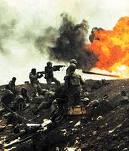
It was something I was not going to do – view the HBO special War Torn.
I tried watching it almost two months ago but didn’t last ten minutes before I had to turn off the DVD. It had too many reminders of suffering associated with the aftermath of combat. Yet, last night I decided to see what it had to say about PTSD, since this has been our mission for the last twelve years – including research & writing.
Throughout the movie there seemed to be a very powerful, recurring theme, a theme of silence. Silence made the veteran a prisoner of his/her own memories. It did not matter what branch of the military a person served – Army, Navy, Marines, Air Force, National Guard…
The role one played during combat was quite expansive, overwhelming individuals who served in all facets of war. From the front lines of combat, to medics, nurses, body baggers, and any person who had participated in the tensions of war. What was similar, however, was the manner in which the experiences were seared on the mind, body, and spirit. This mark of trauma often left the individual with a sense of hopelessness, apprehension, torment, and sometimes shame.
Then, to add insult to injury, when the vet came home… home to a place that he/she would feel safe and normal, returning to civilian life sometimes added greater stress. Many family members and friends simply wanted the vet to be like he was before he left for war. Become normal again.
Perhaps these words might offer some understanding of what isn’t talked about and isn’t said when a war veteran returns home.
THINGS YOU DON‘T TALK ABOUT
By Janet J. Seahorn, Ph.D.
What don’t you talk about,
You survivors of war?
You, who are suppose to be brave,
To be fearless and bold.
You, who have witnessed the best of mankind,
And the worst.
You, who daily endured death;
Who lived with the unknown
The woundedness of others
And the scars within yourself.
What don’t you talk about,
You warriors of battles recent and old?
The panic attacks that grip your throat,
The night sweats from vivid dreams;
Anxieties that propel you to a universe
That seems out of control.
Anger unprovoked and dangerously destructive.
The self-medication… attempts to silence
The voices and erase the gory scenes.
What don’t you talk about
You, who cry with Silent Screams?
You, who cannot seem to find your words,
For words are too simple, too clean
To describe your distress
To others who have no concept of war.
For what you don’t talk about
Your brother and sister warriors understand.
They have been to that place of darkness.
They know – and in that knowing
They are there to walk beside you
If only in spirit.
Perhaps these fellow casualties
Make talk a bit less necessary.
Jun
6
I AM
Filed Under Civilian life, Combat PTSD, Life, Love, Peace, PTSD, Tears of a Warrior, Treating PTSD, Veterans | Comments Off on I AM
by Janet J. Seahorn, Ph.D
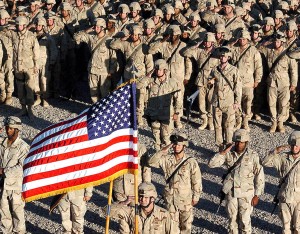
For many of our military men and women who return from combat there is a burning question; a question that asks, “Who am I?” Who am I now that I have seen so much, done so much, and heard the despair of so many? For some there may be a feeling of unworthiness, a gnawing numbness of pain. They seek answers that seem to elude them; answers hidden somewhere between the battle fields and the present.
Every person wants to be validated in the world: to be seen, to be heard, to be felt. Returning from war often leaves a person with a sense of invisibility. A feeling that adds to the question, Who am I … this other person who wanders a world that once was so familiar now feels like a drifter in a land that may not seem recognizable.
Know this one simple truth, You are worthy of love. You are worthy of goodness. You are worthy of a life of joy and personal fulfillment. The trick is not that others view you as worthy. You must believe this for yourself. “You are responsible for your life”. And only You can create and live such a life. You alone must believe that you are worthy to live a good life and a life of meaning.
Combat can take one’s sense of self, but it does not take away one’s need to be a part of something, some mission, some worthy cause. The heartbreaking reality for many veterans is returning from battle with a frame of mind of being untrained to live in civilian society. You will need to work hard to find your path in this world after combat. No one can do this for you. It is a journey each individual will need to travel and seek out.
Some doubt they are up to the challenge. This is purely self deception. If you could be trained to perform all of the incredible feats of a skilled warrior, you certainly have the strength, intelligence and willpower to succeed in becoming your very best “I AM”. The gift has always been yours. It was bestowed on you at birth. The outside world may work hard to convince you otherwise. Some days it may be tempting to give up the search. But carry on. In your hands lies the power to choose.
Choose to accept your very best I AM.
Apr
24
LIVING INSIDE OURSELVES
Filed Under Combat PTSD, Life, Peace, PTSD, Tears of a Warrior, Trauma, Treating PTSD, Veterans | Comments Off on LIVING INSIDE OURSELVES
by Janet J. Seahorn, Ph.D

We reside within our own wondrous environment, within ourselves, and wander about the internal hills and valleys everyday. If we are lucky and have lived a full life, the landscape of our inner country is filled with incredible diversity.
Mountains and valleys only have depth based on the extent of our experiences. The brilliant hues of colors cannot be painted on an empty canvas. Nope, such vividness is achieved through a great many life events: joy, grief, humility, arrogance, chaos, serenity… all mixed throughout the years.
Yet, through all our trials and triumphs, with a bit of luck, our inner artist refuses to put down the paintbrush. Each day offers elements to add to the internal country; an element that increases the vastness of the spirit. Within ourselves we wander with purpose and courage. Trauma takes a toll which only hope can overcome.
We become our best selves not because we lived a safe, comfortable life, but because we have fully lived. There is a huge difference between a life of ease and one of worth. The first took little effort; the latter required a deep sense of duty, sacrifice, relentless perseverance, and sometimes tears. All of these make a life of worth a special gift to the world. A gift that lives far beyond our short existence.
Which life have your lived so far. Which life are you living now? What would your canvas look like? Certainly, like any remarkable work of art, it would have its dark contrasts; yet, I hope it would also contain sweeps of light, touches of brilliant colors, and areas of tender hues which embrace a sense of peace and serenity.
Mar
9
UNCOVER THE SUN
Filed Under Combat PTSD, PTSD, PTSD treatment, Tears of a Warrior, Today's War, Treating PTSD | Comments Off on UNCOVER THE SUN
by Janet J. Seahorn, Ph.D

There are so many ways to experience trauma in the world. Combat is just one, but it is one where the impact keeps on giving and giving. For many whose painful experiences occurred once or twice, many seem to be able to get up in the morning and feel grateful for the opportunity to have a fresh new start. The sun shines brighter and the colors of the world are more intense, even if some nights are seemingly unbearable.
The difference between a one time experience and multiple traumatic occurrences is the cumulative effect. The more often an individual faces harrowing life events, the more likely the brain is going to be influenced by those events. Because the brain is sculpted by experience, everything good or bad can make a difference.
We become who we are due to our genetic foundations and our environment. If that environment is nurturing, safe and challenging in a positive way, we have a greater chance to develop into self-confident, cheerful people. If, however, that environment is saturated with violent, unpredictable and dangerous circumstances the brain molds itself into a survival organism in order to hopefully sustain the trauma. The important thing to remember, however, is the age when a trauma occurs. Earlier is not always better.
We know the brain is not fully developed until the mid twenties (especially in males). So what do you think multiple combat deployments do to a developing brain? For many young men and women the outcome is pretty darn complicated. Connections within the brain are changed. Neurotransmitters, those chemicals in the brain that allow us to feel pleasure, prepare for fight or flight, suffer with depression, and other human experiences are changed. The physical organism that controls our behavior is changed. Trauma is serious business with serious effects for many.
For warriors returning from combat, the world is not as bright and welcoming as it was before war. Sense of identity is changed… you leave as a somewhat naive youngster and return as an adult aged beyond your years. PTSD is like having a gray veil placed over the sun. Sure it still shines. Yes, you can feel the warmth of its rays.
Yet, nothing is the same as before you left. Healing from trauma can be the unveiling of the sun. The way to remove that shroud or at least make it lighter is to seek help as soon as possible. You have the strength to Uncover the Sun. More importantly, you deserve to have the full brightness of its rays lighting your days and warming your heart.
Feb
15
WICKED PROBLEMS
Filed Under Combat PTSD, PTSD, PTSD treatment, Tears of a Warrior, Trauma, Treating PTSD, War | Comments Off on WICKED PROBLEMS
by Janet J. Seahorn, Ph.D
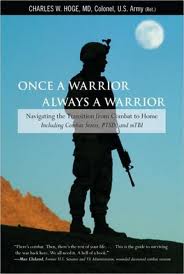
No doubt about it, PTSD is a very Wicked Problem. Wicked Problems, by definition, are those dilemmas that cannot be solved easily by using a typical approach. Anyone living with traumatic stress, especially those pressures caused by combat, will attest to the challenges of trying to solve the predicament of moving through his/her life carrying the memories and phantoms of war. If the solution was easy, it would have been found centuries ago. Yet, here we are today, in 2011, and the Wicked Problem still exists.
One of the Wicked Problems of trauma is surviving the depression that can be a part of the conflict. How does a person live with long-term depression that often becomes the new normal after battle? Constance Gibbons, one of our readers, wrote last week and shared how depression has been the new normal for many vets including her husband. After years of having it a part of their daily being, it becomes their after war identity. She stated: Another interesting aspect from those of us observers – spouses, et al – was that universally we noted the levels of sort of a baseline enthusiasm, whereas, the vet thought they were quite fine.
She explained further: As you continue to think of ‘depression’ as it may be portrayed by the vet, maybe think of a sense of resolution, unknowing acceptance, somewhere in a lower zonal level (between overconfidence and fear) from the years of living on the cusp of life and death, at a level of continuing risk so great that without the impact of the continuing penetration, after, into youthful vulnerability, it appears to those of us in observation to be baseline depression…where it is not to the vet; just an absence of heightened stimulation. Wow, now how would anyone solve such a Problem?
Veterans carry many Wicked Problems – ghosts of death and shocks of battle, memories that make if difficult to stay grounded in every day activities, and struggles to avoid the sleepless nights where staying awake is one way to keep the dreams of foreign battles from returning. New therapies and medications have helped lower the impact of PTSD but it has not solved the Problem. I read many blogs and articles relating combat PTSD to the trauma that the average person might experience. Things such as car accidents, rape, assault… all which are terrible and difficult to cope. Yet, these are hard to compare to combat where trauma occurs every day, often numerous times in a day. One of the biggest differences is besides being the prey, in combat you must also become the predator. Instead of being involved in one brutal injury or death, you may experience many.
Fighting the Wicked Problems of war takes work. It requires listening to your gut feelings as well as how others around you perceive your behaviors. The good fight involves muffling the loud voices in the head long enough to examine realistic solutions. Perhaps there will be no absolute solution to PTSD, but every day there are warriors who conquer their demons and live full and meaningful lives. Wicked Problem you may remain, but you will not take more of a warrior’s life than you already stole. You will not win this internal war, even if you succeed in taking an emotional battle now and then. You see, Wicked PTSD Problem, in spite of your persistent, you are no match for the courage and willpower of a WARRIOR.
Feb
2
A HUMBLED JOY
Filed Under American Patriotism, Civilian life, Combat PTSD, Family, Life, Love, PTSD treatment, Tears of a Warrior, Treating PTSD, War | Comments Off on A HUMBLED JOY
by Janet J. Seahorn, Ph.D
They stood before us, this beautiful, young couple. He had just returned home from a tour in Afghanistan, his second time away. They had many things they could have done that would have been much more fun than taking time to visit with us.
She was a student in my fall semester course at the University. At the beginning of the new semester she let me know her husband would be returning home soon and she wanted Tony and me to meet him. Just the request was a humbled joy. Actually meeting them on that cool winter day even meant more.
During our short time together, we did not talk much about his experiences at war except to listen to a few short phrases indicating he had been in some difficult situations.
I didn’t mention that his wife had to take an “Incomplete” for the college course because she became seriously ill and spent several days in the hospital. Somehow, all of this was now unimportant. The only thing we noticed was how the two people standing before us just couldn’t stop smiling and giggling continually as they held hands, grateful to finally be together.
My goodness, this was truly the picture of humbled joy.
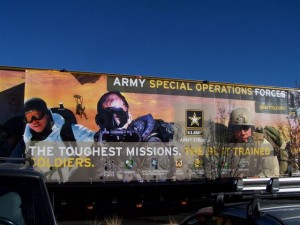
That same day we spoke with an army Special Forces warrant officer who was helping to show students on campus the various skills and equipment used in the military. The young man explained that he had been in the army for sixteen years, joining-up right after high school. Honestly, he didn’t look like he was that old; he smiled widely when I shared my observation with him.
He talked about how joining the military at age seventeen was the best thing he has ever done. The army, he noted, gave him direction, guidance, and supported his development as a confident adult. The interesting detail about our conversation was how much I learned in a short time about his confidence as career military person.
At the beginning of our chat I asked how many times he had been overseas; five – six times if you counted a stint in Romania. The duration of each tour was between three and eight months depending on the mission. During several of his assignments he experienced the reality of war, including several casualties within his unit.
Yet, in spite of the stress, he seemed to be coping with the emotional and physical side effects of combat pretty well. It was challenging, he noted, to reintegrate into “normal” life on each return home, but the army gave him plenty of support and time to decompress.
He pointed out that on several occasions he was given a lengthy mental survey of over 115 items which sometimes highlighted his PTSD tendencies. Nevertheless, because he was career army, his adjustment process appeared to be faster and more comprehensive than veterans who left the service shortly after returning from battle. There does seem to be some significant benefits for the men/women who are in the military long term.
Perhaps being in a community of individuals who have experienced similar battle conditions helps the healing and understanding process. Being around other soldiers who can identify with the pain of combat; others who quietly appreciate the sacrifice of serving our country may lessen the feelings of emotional trauma of being alone in a world where most people haven’t experienced war. This, by itself, would be an immense relief because one wouldn’t have to pretend everything is OK when it isn’t. You wouldn’t have to go through each day feeling lost and alone because there would be a band of brothers surrounding you with knowledgeable support. At any rate, this young soldier certainly gave me some things to think about.
Humbled Joy, invisible, yet real. Thank you.