BOOK PURCHASE: Discount (above) or PayPal (below)
Click "Buy Now" to continue to PayPal
Click to order eBook - Kindle

Click to order eBook - Nook

Mar
11
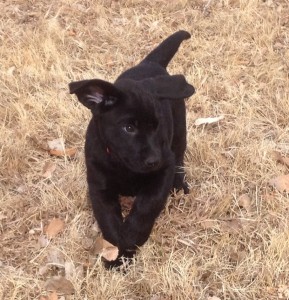
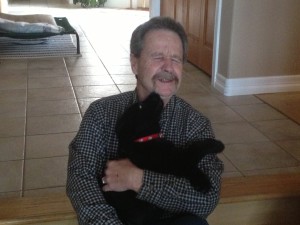
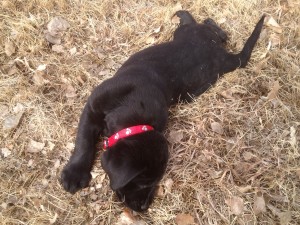
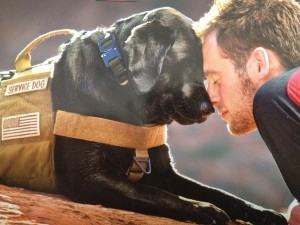
Best Friends
Filed Under Aging, American Patriotism, Combat PTSD, Dog is God, Dogs, Happiness, Healing, Military, Pets, PTSD, Service Dogs, TBI & PTSD, Tears of a Warrior, Tribute, Veterans, War, War Dogs, Wounded Warriors | Comments Off on Best Friends
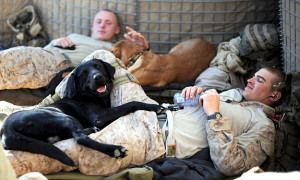
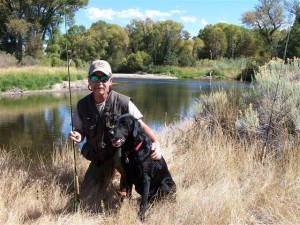
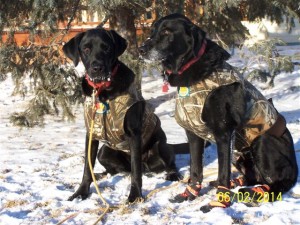
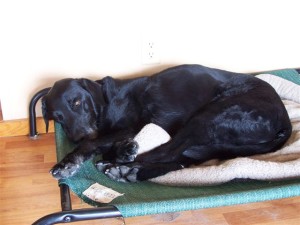
Guest Blog by John DiCiacco

![41Q+ek-yDrL[1]](http://www.tearsofawarrior.com/wp-content/uploads/2018/03/41Qek-yDrL1-1-230x300.jpg)

Mar
1
Settling into the Year 2018
Filed Under Aging, American Patriotism, Bless Our Troops, Courage, Dog is God, Dogs, Family, Happiness, Happy New Year, Journey, Love, Service Dogs, TBI & PTSD, Tears, Tears of a Warrior, Veterans | Comments Off on Settling into the Year 2018
by Janet J. Seahorn, Ph.D
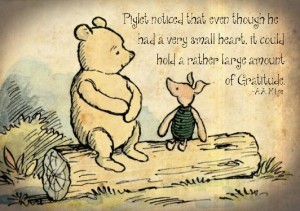
Now that we’re well into the New Year, and thinking about moving forward into a year of fresh beginnings. Remembering and preserving old friendships, being aware and grateful for an abundance of goodness, people, health and purposeful work that occupy our days can offer a sense of optimism. Yet, most important, having a richness of love in our lives – love of family (yes, even those that sometimes drive us nuts), love (and loss) of endearing pets, love of neighbors and friends, and love of something within and above us that help to guide us through the darkness.

For some that light may be almost infinitesimal dim. Bob Woodruff, a well-known journalist and author who suffered a devastating brain injury from an IED while covering the military in Iraq wrote in his book “In an Instant“, “First you must touch the black and then go back up to the light.” It was his way of “acknowledging that you have to let the fear in, but to dwell on the fear will only cripple you. You need to move back into a world of hope.”

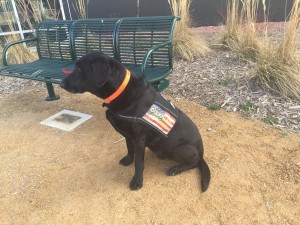
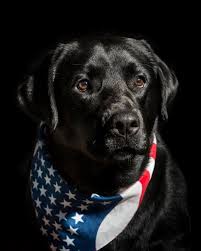
There is no denying that 2017 was a year of great challenges and loss for many, and 2018 hasn’t been easier with the recent death of our beloved service dog, Bailey. Family members, treasured pets and very dear friends are no longer with us. Saying goodbye has never been easy even when we recognize that it is for the best (at least for that loved one).

However, we are trying hard to center on the plentiful blessings in our lives. The old saying, “It is just as easy to focus on being positive as it is to be negative”, every so often can seem like a big bowl of crap. Advice to the reader – listening can be more important than trying to comfort an individual by making comments such as “Suffering builds character”. I’ve never believed that old cliché. I think suffering reveals character more than builds it. Sometimes, we simply need to allow ourselves and others to grieve, to be sad, and to nurture our physical and emotional selves.

Nonetheless, I still believe that life is worth the time to live fully and with resolve. I still believe that most people are generous and decent. I still believe that compassion trumps unkindness and hate generates more cruelty in a world already filled with too much bitterness. I still believe that truth is more important than ever to counteract the deceit and false narratives of which others try to convince us. And, more than ever, I still believe in hope, for without hope it would be hard to wake up each morning with a sense of joyfulness.


Lastly, for our veterans, first responders and their families we wish you a year filled with peace, prosperity, and well-being.
You’ve sacrificed enough.

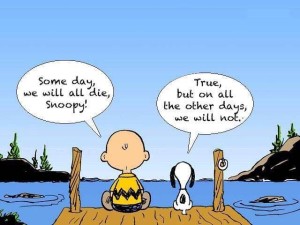
Daily count your blessings and know how precious those special moments can be.
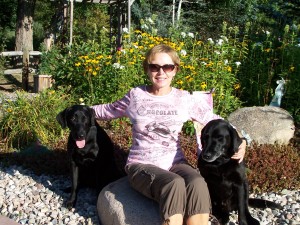
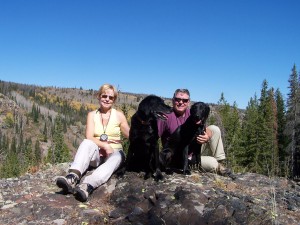
Now it’s time to enjoy an exceptionally amazing New Year.




Mar
23
TED TALKS AND PTSD
Filed Under Brain Injury, Dogs, Post-Traumatic Stress "Injury", PTSD, PTSD treatment, Service Dogs, TBI & PTSD, Tears of a Warrior, TED Talk, Vietnam Today, Wounded Warriors | Comments Off on TED TALKS AND PTSD
By Janet J. Seahorn, Ph.D
 TED (Technology, Entertainment, Design) is a global set of conferences run by the private non-profit Sapling Foundation, under the slogan “Ideas Worth Spreading”.
 It continues to be an overly busy few months. We are waiting for things to slow down a bit, yet, as soon as we are done with one “To Do List” another pops up with an even bigger task sheet. It begs the question as to whether we are really that harried, or if we are more easily exhausted because we aren’t all that youthful any more. OK, don’t go to that disheartening place.
 A few weeks ago, I had the opportunity to do a TED Talk at Colorado State University where I’m a professor in the Education College. Of course my topic was Post Traumatic Stress. After months of putting together the talk and multiple practice sessions, the day finally arrived. Truthfully, when I was first accepted as a speaker I was quite excited. As the day for the TED event grew closer I became more anxious. It wasn’t the fear of talking in front of large groups of people – we do that often. It was trying to fit twenty years of research and essential information into a fifteen minute timeframe that drove me to panic. This was more like the old television show, Name That Tune, in which the contestant was given only the first three or four notes of a song and expected to know its name; a seemingly impossible task for discussing Post Traumatic Stress and its effects on the brain, body, and spirit.
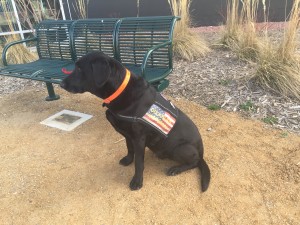
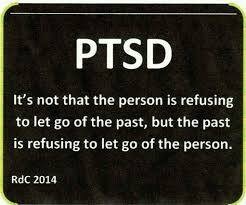 As I entered the stage area I felt like Katniss from the Hunger Games, going into a life and death battle without the proper equipment. You will have to listen to the talk (the information is in this blog), to see the results. Be sure to go to watch the very end for a surprise appearance of our service dog, Bailey. Tony, unbeknownst to me, brought him to the event and sent him up on stage at the very end of my talk. OMG!!!!
Ted Talk: 15 minutes worth hearing!
Understanding PTSD’s Effects on Brain, Body, and Emotions | Janet Seahorn | TEDxCSU – YouTube
https://m.youtube.com/watch?v=BEHDQeIRTgs
Oct
31
STRENGTH OF SPOUSES
Filed Under Combat PTSD, Healing, Spouse, Stress, TBI & PTSD, Tears of a Warrior, Trauma, War | Comments Off on STRENGTH OF SPOUSES
by Janet J. Seahorn, Ph.D

In the past few years, I’ve written countless blogs on the strength and endurance of our veterans. However, the other side of that coin is the strength and endurance of their spouses. Several days ago we received an e-mail from a spouse who had heard about us and our book through an article that appeared as a Wyoming magazine article. She wrote about the challenges of married life with her veteran husband. A situation that became even more desperate after he suffered a traumatic brain injury (not from combat) that she wrote, “took him totally out of commission”. The e-mail went on to describe how other people did not see the depth of his many wounds, but she was faced with them daily enduring aggressive behaviors and foul language.
The injury occurred in 1998, but it was not until 2001 that the situation became too difficult to bear. I was his sole caregiver & therapist. When things got bad, I was the human standing in front of him as his anger came out.

… There were many days of not sleeping and warding off his craziness. In the first two years after his head injury, we almost lost the house twice. We literally lived in a wooden tent – the house was emptied out of furniture and appliances as the sheriff’s department kept impounding our possessions because we couldn’t pay our bills – possessions which ended up on the court house steps selling for $1. My daughter and I sought safe shelter six times in those two years to get away from him and his outbursts – the first time was on her 10th birthday.
One may think, wow, this sounds pretty darn extreme, yet, due to the lack of available resources in her area, obtaining services was nearly impossible. Her state of affairs is not unlike many of our returning military people and their families. Many spouses are drained of energy trying to keep their loved one out of jails and mental health institutions. What makes her story even more thought-provoking is her educational credentials, during all the turmoil she went back to school and obtained a Master’s degree in mental health. Yet, she has had to fight her own demons brought on by the many years of being exposed to an unpredictable and toxic home environment.
With her educational background she states, I have dissected trauma and I understand the roots of it more than most people.
And perhaps, her most profound statement,
Unfortunately, the war doesn’t stop when they come home. They never leave the ambush; it can haunt them for the rest of their lives. They are eventually removed from the war situation and are not confronted with that type of environment every day (other than their memories). Their spouses and children aren’t so lucky. They too have to live with the aftermath of war.
Thank you, Carol, for your introspective thoughts, your daily courage, and your persistence to keep going even when it would be easier to give up. You are certainly one of our country’s many amazing military spouse.

Jul
23
I SAW GOD TODAY
Filed Under American Patriotism, Giving, Healing, Healing Waters, Soldier, TBI & PTSD, Tears of a Warrior, Treating PTSD, Wounded Warriors | Comments Off on I SAW GOD TODAY
by Janet J. Seahorn, Ph.D

I saw God today. He appeared in many forms and shapes. Some were tall with crippled arms and legs. Some were young with broken hearts and tangled minds. One was weathered with a long, white-bearded, grizzly face. Amazing how God changes and morphs into such diverse appearances. Yet, each face had eyes that seemed to explain wisdom, pain, and hope.
As with such celestial beings, God tends to surround himself with legions of angels. They support, guide, and maintain an environment of light and joy. You see, God cannot do all the tasks he has to accomplish without some assistance.

Such was my experience with the second annual Wounded Warrior Event held in Saratoga,Wyoming. The faces of God traveled in metal chariots through high mountain ranges and wide fields of swaying hay. When the convoy arrived at their destination they were welcomed by the hosts of the Saratoga Resort. Once settled in rooms filled with cowboy furnishings, God was taken to the beautiful Upper Cedar Creek Ranch owned by Tom and Dixie Arthur. Horses and a special mule named Henry awaited His arrival ready to gently carry God to a pristine mountain lake where he could rest, fish, and replenish his mind, heart, and spirit. Angels continually encircled him, focused on quietly serving and ensuring His few hours on the mountain were peaceful and revitalizing.

The following morning God had one more opportunity to experience the splendor of hisWyoming landscape where He engaged in amazing fishing at Big Creek Ranch. New adventures lead by Mark Dunning facilitated hours of fun and entertainment. The day culminated in an evening barbecue with appreciative community members and the staff of the Saratoga Resort led by general manager, Susan Wallace. Each simply sought one last chance to say thank you. Thank you for your service. Thank you for your sacrifice. Thank you for your courage.
Finally, God was sent on His way with a goodbye breakfast provided by the town’s American Legion Post.
Yes, I saw God today and I was blessed, both by his presence and his multitude of angels who continue to give so much to keep us safe and free. And once again I realized how even God within every individual needs time to rest, to replenish, to experience peace in order to persevere with the journey ahead. As you go through your hectic days, take time to see God in those who pass your way and be grateful for the divine in each being’s special presence.

Apr
17
CAN YOU HEAR ME NOW?
Filed Under Aging, Brain Injury, Combat PTSD, Events, TBI & PTSD, Tears of a Warrior | Comments Off on CAN YOU HEAR ME NOW?
by Tony Seahorn

Every once in a while we get presented with a special opportunity that may change or at least have an impression on our lives. This happened to me a few weeks back. I was asked to be a member of a panel of veterans who had hearing loss and tinnitus due to combat exposure. The panel was part of the National Joint Defense Veterans Audiology Conference (JDVAC) which is held around the country each year. This year’s event was held at the Omni Hotel in Dallas,Texas.
Of the six veterans participating on the panel, all of us also had PTSD and a couple with TBI. We all agreed that most veterans with severe hearing loss have other scars from war that often add to the severity of individual disabilities.

From the time we arrived we were treated like royalty: beautiful rooms, a basket of goodies delivery shortly after we arrived, and even free coffee and lattes. Unfortunately, Jan was unable to go with me due to her teaching commitments at CSU. I’m not sure whether she was most jealous of the basket of goodies or all the free lattes she could have during my three days at the conference.
Maybe I should backtrack a bit. Ever sinceVietnamI have struggled with tinnitus, ringing in my ears. For the most part I have been able to endure the buzzing in my ears, that is until last November. One night I went to bed with the “normal” ringing. However, in the morning I awoke with the sound being far worse than ever and I had lost most of my hearing in my right ear. My hearing loss was also accompanied by dizziness.
After several doctor visits and antibiotics, I was told that the ringing would probably never get much better and my hearing would not fully return. Fast forward a few months and this special opportunity to be a part of a conference with some of the best hearing specialists in the country.
My panel was made up of eight individuals: two audiologists and six veterans. Each panel member contributed, not just telling their combat story, but how being hearing challenged impacted their lives. The entire session was taped and will be presented in a video and streamed on the sponsor Hamilton CapTel® Web site which will reach hundreds if not thousands of viewers throughout their network.

Following the conference, one veteran wrote in an e-mail …Our feeling is that we have to start somewhere with this important message. Hopefully, as we look back at our endeavors a year from now, we’ll see encouraging progress that not only includes larger veteran audiences for this panel at industry events – but more importantly, increasingly open “solutions” dialog between hearing health care professionals and the veterans they serve.
For all of you vets who are living with a hearing problem, I truly believe help and hope is on the way. I found that support and optimism in Dallas. The experience has been such a blessing. To think I almost didn’t attend this event.
Following is a message from Judi Victor in her capacity of Panel Director:
Hi, JDVAC Holistic Panel Team!
Tina and I are having trouble finding the right words to thank you for your participation in the Holistic Hearing Healthcare Panel at JDVC on Tuesday. Each of you contributed so much to the discussion; we can’t imagine a more articulate, informed, bright or inspiring group. It was, indeed, impressive – and to think that the entire panel had never rehearsed together until a few hours before the actual event is truly amazing!
Even though our “live” audience was not gigantic, please keep in mind that we are editing the video presentation to stream on the Hamilton CapTel® Web site, which will reach hundreds if not thousands of viewers. In addition, the video will be shown in part or in its entirety at other industry events throughout the coming year.
Our feeling is that we have to start somewhere with this important message. Hopefully, as we look back at our endeavors a year from now, we’ll see encouraging progress that not only includes larger veteran audiences for this panel at industry events – but more importantly, increasingly open “solutions” dialog between hearing health care professionals and the veterans they serve.
We know that this event required a huge effort on your parts, not to mention the fact that it took you away from your work, families and many other activities. Please know that your participation is appreciated more than we can ever express.
With warmest regards and deepest gratitude.

Mar
12
EXPLAINING PTSD IN A VIDEO
Filed Under Combat PTSD, PTSD, PTSD treatment, TBI & PTSD, Tears of a Warrior, Trauma, Veterans | Comments Off on EXPLAINING PTSD IN A VIDEO
by Janet J. Seahorn, Ph.D
For centuries societies have been trying to explain why warriors return from combat “stranger” than before they had left. In our book, Tears of a Warrior, we wrote about how the Roman’s sent their troops who had recently arrived back from battle to a tranquil farm away from the city to recoup from their emotional wounds.
It seems like every war had its own special term for such suffering; words such as combat fatigue, shell shock, warrior’s heart, etc. However, none of these really explained much about why the individual wasn’t able to put the war behind them and get on with their lives.
Joe Novak, another of our readers sent this YouTube video to Tony. For the person who has never experienced combat, this will be an informative eight minute clip which both “shows” and “tells” the effects of battle. For those who have been to hell and back, you may not need to view the film; you have already lived it. If you do, keep the last message in mind as you continue your healing journey back to your new normal.
http://www.greatamericans.com/video/Vietnam-Vets-and-PTSD;Veterans-Videos
Blessings and, once again, Thank You for Your Service.
Tony and Jan Seahorn
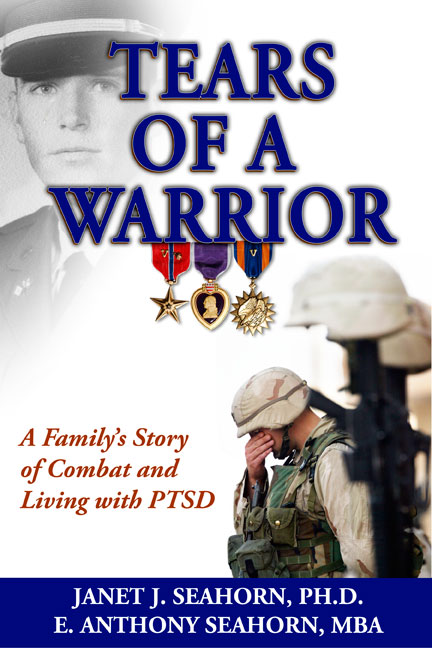
Both KINDLE & NOOK can be ordered directly from our website.
Feb
10
A HOLOCAUST OF THE SPIRIT
Filed Under American Patriotism, Holocaust, PTSD treatment, TBI & PTSD, Tears, Tears of a Warrior | Comments Off on A HOLOCAUST OF THE SPIRIT
by Janet J. Seahorn, Ph.D

It is interesting how many people still have not heard of Post Traumatic Stress. It’s as if they have been living under that rock in the Geico commercial. Maybe part of this circumstance is due to the fact that less than 1% of Americans are currently serving in the military. During WWII one could walk down most streets throughout the U.S. and count at least five houses that had a star in the window.
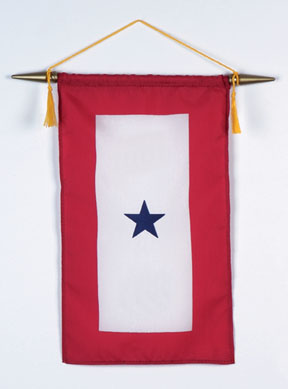
Today, as in the Vietnam War, we no longer have signs that signify to others that a family member is serving overseas. Little is shown to symbolize the sacrifice of the few. Somewhere a child is missing his father or mother each night before she goes to bed. Somebody’s mother may be crying herself to sleep again, worried sick about the safety of her child. A spouse is having to carry on every detail of daily chores by herself/himself and doing it each day with a loneliness that shatters the heart.
Many ask us what it is like living with PTSD. For me, I think the best description is the trauma of combat leaves many vets with a Holocaust of the Spirit. Webster’s Dictionary defines holocaust as a “vast or total destruction, usually by fire; great loss of life or property; a sacrificial offering consumed by fire”. Such a description is pretty accurate when you think about it. During battle, not only is there physical fire, there is the mental and emotional fire — a fire in the heart, brain, and soul. Then there is that word “sacrifice”. Sacrifice is always the consequence of any combat experience: sacrifice for one’s country, sacrifice for unknown people in unknown areas of the world, sacrifice for one’s fellow troops, and sacrifice of families left behind to wait and pray for their loved one’s return.

As with every Holocaust, loss of life is ever present. And that life, if one survives, will never be the same. The fire of battle has consumed what a person was before the experience, and left him with scars that tend to break and reopen with the living of each new day. It is a never ending journey towards healing. Some days are better than others, but not one day is ever the old picture of “normal”.
Yet, here is the important part of any Holocaust to remember … It can be survived! Like the mythical bird, the Phoenix, who was burned beyond all recognition and rose from its ashes to become an immortal body and spirit, many of our PTSD burdened veterans achieve a similar destiny. Both are warriors of distinction and beauty. Both died in their own painful fire, and both became molded into something purer in spirit and stronger in mind and body.
It is easier to endure the fire if you can hold onto something precious to the heart and spirit. Therefore, I included the following old Pueblo Indian Blessing that my brother recently shared with me (365 Days of Walking the Red Road)
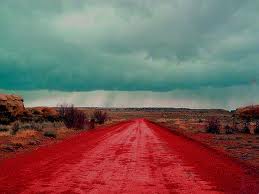
Hold on to what is good, even if it is a handful of dirt.
Hold on to what you believe, even if it is a tree that stands by itself.
Hold on to what you must do, even if it is a long way from here.
Hold on to life, even if it is easier to let go.
Hold on to my hand, even if I have gone away from you.

Oct
7
WARRIOR DEDICATION
Filed Under Brain Injury, Combat PTSD, PTSD treatment, TBI & PTSD, Tears of a Warrior | Comments Off on WARRIOR DEDICATION
by Janet J. Seahorn, Ph.D
Here is a question to think about…how many of you would take your entire retirement in one lump sum and then put it into a facility that would serve as a place of support, safety, and relaxation for our country’s vets?
This special place would require quite a bit of work. You would need to paint the walls, put in new furniture that would be comfortable and calming, and develop programs that would facilitate a wounded warrior’s emotional and physical well-being.
Such a facility would need quiet places where an individual could find the best environment to heal. For instance, one room would serve as a large conference room for presentations and discussions. Another would be a smaller area with a number of large reclining couches as well as chair recliners. My favorite happens to be a room with three oversized, state of the art massage recliners.

Each of the two “relaxation” rooms is equipped with head phones to listen to select music of choice under dim lighting. Small water fountains provide a sense of a quiet, flowing river. A large screen TV scrolls messages of hope and inspiration. Every detail was thoughtfully conceived to provide a special place of peace.
And here is the amazing thing, the person who has formed this sanctuary does not charge one cent for a veteran or family member. The Warrior Relaxation Response Center is located on the south side of Colorado Springs, CO, close to Fort Carson military base. It has been open barely a year. To continue to provide these services, the owner, Antoine Johnson, is desperately trying to obtain grants from various organizations as well as the army’s military base.
With a challenging economy, this will be no easy task. As Antoine tells it, “It is a true leap of faith”. He explains that he simply loves the military men and women who served our country. He and his wife spent many years in the army, fought in Desert Storm, and then became teachers. Working with traumatized children became his specialty. Many of the children came from military families torn apart by combat deployments, with parents returning with TBI and PTSD. Antoine saw a calling to help those returning from war to achieve a more stable and balanced life.

Last Thursday we were invited to visit the center and speak to some of the veterans and their families. Young and old were present, each with a story of trauma The flashbacks, the lack of understanding from family and friends who have not had to endure war, the numbing of the senses just to get through the day, and the sometimes overwhelming anxiety of not knowing when the next emotional attack will occur.
Throughout our country there will be an even greater need for more centers like the Warrior Relaxation Response Center A place where an individual can visit to simply be alone and find some solace. A place where he/she will not be judged, asked questions, or encouraged to just get on with living. Sometimes, as Antoine understands, a warrior simply needs a quiet space. Healing takes time, often a lifetime.
For those who want to contribute to support this mission or learn more about the facility please contact Antoine Johnson: http://www.warriorrrc.com
May
19
TOUCHED BY COURAGE
Filed Under Brain Injury, Combat PTSD, Events, Family, Giving, Life, Love, PTSD, TBI & PTSD, Tears of a Warrior, Trauma, Veterans, Wisdom | Comments Off on TOUCHED BY COURAGE
by Janet J. Seahorn, Ph.D

A few weeks ago, Tony and I spent several days in the Grand Strand area of Myrtle Beach, South Carolina.
It was Military Appreciation Week.
Due to the special invitation of Retired Army Officer Sinclair Swan, we had the privilege of working with two local groups of military veterans, their spouses and family members.
During the day we met with several group members and their spouses. It was an amazing opportunity to not just speak to the individuals in attendance, but to listen and hear their stories as well. Each account reminded us of the enormous amount of courage it takes to get up each day, live it as best one can, and give back to others.
Two of the veterans have adult children who experienced traumatic car accidents which left them with severe head injuries. These vets are now the primary care givers. Not only have they endured their own trauma; now they must bear the suffering of their children. Several are challenged by serious health issues for them and/or their spouses.
Yet, they continue with great effort and fortitude to move forward. It is a humbling gift to have others shares their trauma and heartbreaks.
Contrary to some public perspective, most of these vets have lived and are living successful and productive lives. In spite of their demons, they have deliberately chosen to not let the past destroy the future. They have elected to make a difference for themselves, their families, their communities. Sinclair Swan meets every Saturday with vets who need help in filling out government forms to obtain services. Each has made significant contributions to serving others.
One individual wrote a special poem many years ago. Upon returning from Vietnam he described how he became homeless, sleeping in parks, and getting his “fixes” when needed. Then, one day, another homeless friend suggested they go to a church soup kitchen for a meal. It was there that a miracle occurred and his life changed. He got his faith back, his spirit, and eventually his life. At that time he wrote a poem which he has allowed us to share with you.
A Poem
By William Huffaker
If I only had one wish to make,
but that wish would surely come true.
I’d wish that I would be given the light
to turn the darkest sky into blue.
Now to you this may sound
like my mythical dreams
have blurred my vision
so that this only seems
to be an illusion
of hopeful abound,
and that my wish
I’ve not really found.
But I’ve found it I tell you.
As I’ve sought it in truth.
And I know now this answers’
been here since my youth.
But I just couldn’t see
through the clouds in my mind.
Through delusions of grandeur
I just couldn’t find.
This fabulous dream
that just had to be,
waiting and knowing,
someday that I’d see.
And even though skies
still sometimes turn black.
And visions of grandeur
still sometimes come back.
I know that there’s light
in the darkest of night.
And the tenderest loves
never far from my sight.
And now that my dream
has become something true.
If I had one more wish,
I would wish it for you.